FDA · Data Integrity · AI Governance
The Data Integrity Problem AI Just Made Harder to Ignore
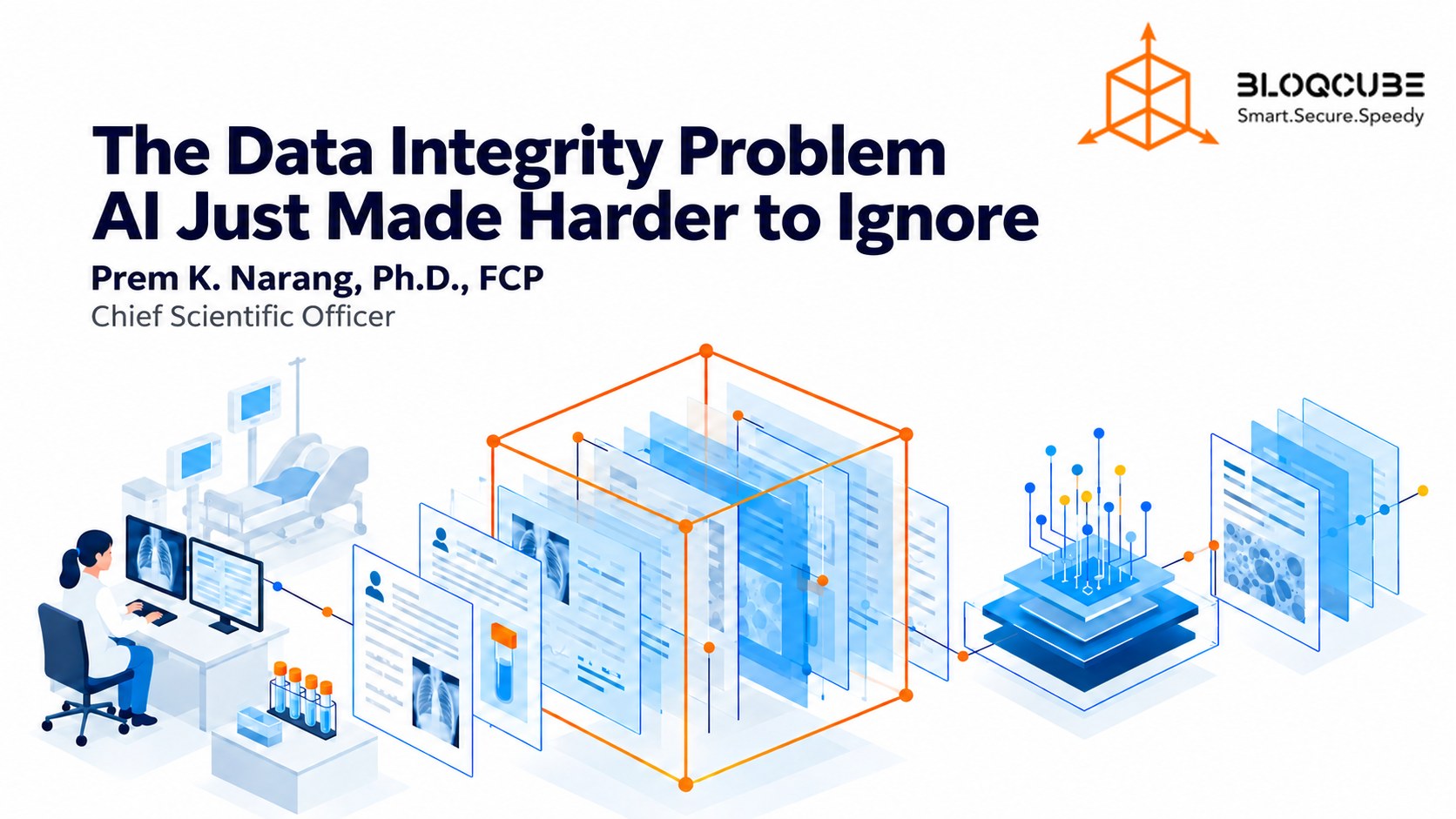
Clinical trial data has always been under scrutiny. The FDA’s 2018 Data Integrity and Compliance with Drug CGMP Guidance [1] made that scrutiny structural: electronic records must be attributable, legible, contemporaneous, original, and accurate. ALCOA was never optional. But for years, many sponsors treated it as a documentation exercise, something to demonstrate during inspection, not something to engineer into the platform from day one.
The 2024 FDA guidance [2] closed that gap. Organizations must now implement validated computerized systems, comprehensive audit trails, documented governance procedures, and procedural controls that preserve the integrity of electronic records from creation through archival. ALCOA+ extended those expectations further: completeness, consistency, endurance, and availability throughout the entire record lifecycle. Transparency and traceability are no longer inspection-readiness concerns. These are baseline requirements for any data submitted as regulatory evidence.
That standard was already difficult for many organizations running on legacy clinical systems. Then came January 2026.

What the FDA’s AI Principles Changed

The FDA’s January 2026 AI principles guidance [3] extended the same evidentiary expectations into AI-enabled drug development. AI-generated evidence must now be supported by transparent governance, documented context of use, risk-based credibility assessments, reproducible outputs, lifecycle monitoring, and human oversight. Sponsors are expected to demonstrate not only that an AI model performs adequately, but that its inputs, assumptions, version history, and performance remain auditable over time. AI systems become subject to many of the same evidentiary standards as the underlying clinical and manufacturing data they consume.
This potentially creates a compounded challenge. Clinical data, laboratory results, imaging outputs, and patient-reported outcomes all can flow into AI systems that generate insights for dose decisions, endpoint analysis, and safety monitoring. If the underlying data cannot be proven authentic and unaltered, the AI conclusions derived from it cannot be trusted. The model is only as credible as what it was trained on, and what it continues to consume throughout the trial.
Most clinical platforms were not built with this in mind.
The Architecture Gap

Consider what happened when a small biotech company was forced to cancel a $35 million clinical trial because its data could not be trusted [4]. After review, the sponsor concluded that portions of the trial data were unreliable. Years of work were set aside. Patients who had enrolled were left without answers.
The industry calls situations like this “data integrity issues.” That framing understates the real impact. When trial data cannot be trusted, progress stalls, capital is wasted, and confidence in clinical research erodes. This is not an isolated case. The pattern points to a systemic architecture problem that does not often receive enough public attention.
EDC systems, CTMS platforms, and laboratory data aggregators were designed to collect and store data. Audit trails exist, but they are system-specific, fragmented, and reconstructed on demand. When a regulatory reviewer asks whether an AI model’s training data was tampered with between collection and analysis, or whether a protocol amendment altered the interpretation of earlier records, most organizations cannot answer that question with direct, time-stamped, tamper-evident proof.
The ALCOA+ principles describe exactly what these architectures fail to guarantee. Data can be accurate at the point of entry and untrustworthy by the time it reaches analysis. Completeness and consistency cannot be confirmed across platforms that do not share a unified chain of custody. Endurance and availability mean nothing if the records underpinning them can be overwritten, modified by system updates, or unavailable at inspection.
That gap is not a documentation problem. Better procedures will not close it.
What a Trust Layer Requires

Addressing this requires a different architectural approach, not a better version of the same system.
Blockchain-enabled data platforms offer a structurally distinct answer. By creating immutable, cryptographically secured records of every data transaction, protocol amendment, AI model version, and user interaction, blockchain can strengthen compliance with FDA expectations for auditability, provenance, and tamper-evident recordkeeping. Bloqcube’s Remote Clinical Trial (RTCT) platform operationalizes this architecture across hybrid clinical trial sites, maintaining a continuous, tamper-evident chain of custody from patient data collection through regulatory submission.
The distinction matters. Blockchain does not replace existing clinical infrastructure. Rather than displacing validated clinical systems, it serves as an independent trust layer that preserves an immutable chain of custody across EDC, CTMS, laboratory, imaging, and AI analytics platforms. A record written to a blockchain cannot be altered without creating a visible, time-stamped discrepancy. This property is what makes it structurally better aligned with FDA expectations.
For AI governance specifically, this matters because AI model versions, input datasets, and performance checkpoints can be anchored on-chain. A regulatory reviewer can verify not only that the current model performs as documented, but that the data it consumed at each stage of the trial was authentic and unmodified. This approach enhances inspection readiness, simplifies reconstruction of regulatory evidence, and increases confidence that AI-generated insights are derived from authentic, unaltered source data.
Combining explainable AI with immutable data provenance addresses both dimensions of the January 2026 guidance simultaneously. As AI becomes more deeply integrated into drug development, that combination may become a defining differentiator for organizations seeking to demonstrate regulatory-grade transparency and sustain trust in digital evidence.
The Strategic Implication

Sponsors and CROs that invest in this architecture before their next inspection are not over-engineering their compliance programs. They are building the evidentiary infrastructure that FDA expectations now require, and that AI-integrated trials will demand as standard.
The organizations that continue treating data integrity as a documentation problem rather than a platform problem are likely to struggle. When AI is embedded in trial operations, every structural weakness in the underlying data architecture becomes a weakness in the AI evidence. That is not a future risk. Regulators published that standard in January 2026.
The question is whether the platform your trial runs on can prove, at any point and without reconstruction, that the data was never altered. Most cannot and at the end most find it very time consuming. That is the problem the next generation of clinical infrastructure systems exists to solve, and the reason data integrity can no longer be treated as a GxP checkbox.
If you are evaluating whether your current platform can meet this evidentiary standard, we would like to talk.
References
- U.S. Food and Drug Administration. Data Integrity and Compliance With Drug CGMP: Questions and Answers. Guidance for Industry. Center for Drug Evaluation and Research, Center for Biologics Evaluation and Research, Center for Veterinary Medicine. Silver Spring, MD: FDA; December 2018. Docket No. FDA-2016-D-1113. Available at: https://www.fda.gov/media/119267/download
- U.S. Food and Drug Administration. Data Integrity and Compliance With Drug CGMP: Questions and Answers. Guidance for Industry [Updated]. Silver Spring, MD: FDA; 2024. Available at: https://www.fda.gov/regulatory-information/search-fda-guidance-documents/data-integrity-and-compliance-drug-cgmp-questions-and-answers-guidance-industry
- U.S. Food and Drug Administration; European Medicines Agency. Guiding Principles of Good AI Practice in Drug Development. Joint FDA-EMA Publication. Silver Spring, MD: FDA; January 14, 2026. Available at: https://www.fda.gov/media/189581/download
- Piller C. Alzheimer’s drug developers accuse clinical trial sites of faking data. Science. January 7, 2026. Available at: https://www.science.org/content/article/alzheimer-s-drug-developers-accuse-clinical-trial-sites-faking-data
- International Council for Harmonisation of Technical Requirements for Pharmaceuticals for Human Use (ICH). ICH E6(R3) Guideline for Good Clinical Practice. Step 4 Final Guideline. Geneva: ICH; January 2025. Available at: https://www.ich.org/page/efficacy-guidelines